
Webster Parole and Probation
Parole is a conditional community release from a prison sentence. The West Virginia Parole Board decides whether to grant, deny, revoke, or discharge parole, while WVDCR Parole Services handles day-to-day community supervision. Probation is different. A Webster County court may impose probation as an alternative to confinement or as part of a sentence, and the judiciary administers that order. Mandatory post-release supervision is a third status created by state law for specified felony categories. It follows physical release, but it should not be called ordinary parole or probation.
The distinction controls where to look. A Parole Board order may show a grant, denial, revocation, or discharge. A probation order, modification, revocation, or discharge remains in the court record. WVDCR records can document the effective parole-release date and later supervision events. None of these statuses can be inferred just because a person no longer appears in the Central Regional Jail search. The person may have transferred, left custody without supervision, or moved under another authority.
| Status | Who creates it | Best verification record |
|---|---|---|
| Parole | West Virginia Parole Board | Board decision plus WVDCR parole-release or discharge record |
| Probation | Sentencing court | Court probation, modification, revocation, or discharge order |
| Mandatory supervision | State law and WVDCR sentence computation | Current WVDCR timesheet and supervision record |
Important: A supervision label must come from an official order or record, not from an absent jail-search result.
Verify Webster Post-Release Supervision
No verified public statewide directory lists every compliant parolee and probationer. Telephone routing and focused record requests are therefore primary access channels. Begin with enough facts to distinguish the person: full name, birth information, offender ID when known, sentencing county, and case number. A name alone can lead to the wrong case.
- Find the Webster County case and read the controlling disposition. Determine whether it ordered probation or followed a state prison sentence.
- For parole or mandatory supervision, contact WVDCR Region 6 and ask which office owns the case. For probation, contact the sentencing court or its probation office.
- Use the official Escapees and Absconders list only if failure to report is at issue. A missing name does not establish compliance or discharge.
- Request the dated record that answers the question, such as a parole-release, revocation, supervision-discharge, or court discharge order.
- Compare the status with the physical custody record. A parole grant is authority for conditional release, not proof that release processing finished that day.
For the broader custody trail, the Webster County released-inmate search path explains how to compare both OIS populations, VINE, court orders, and the DCR release or transfer record. Those sources help separate community release from a move within corrections.
Note: Record the date and office contacted because supervision assignments and live custody data can change after a search.
Webster Supervision Office Routing
Webster County sits in the Northern District's Region 6 for state parole. The official organization page places Webster with twelve other counties. Two Region 6 office pages list Webster among the counties served, but the research does not establish which office or officer owns any one case. Do not guess based on distance. Call with the person's name and OID, if known, and ask for the right route.
The WVDCR Parole Services organization page shows this regional structure. Its captured view appears below.
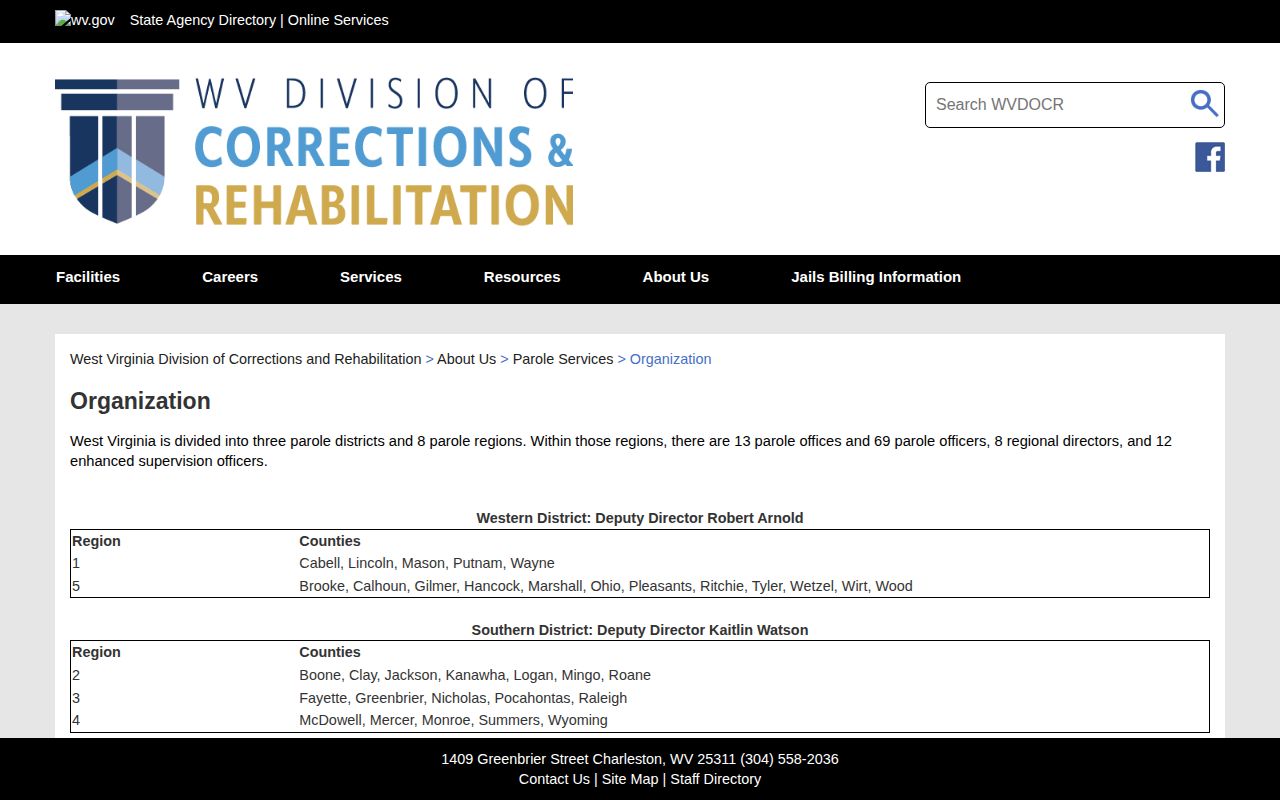
The regional page confirms the county assignment, while the specific office pages supply the contact details used for routing.
Elkins Parole Office
1513 Harrison Avenue, Unit 27
Elkins, WV 26241
304-637-0379
Clarksburg Parole Office
215 West Main Street
Clarksburg, WV 26301
304-627-2308
Webster Probation Office Routing
Court probation follows a separate route. The West Virginia judiciary's Webster County directory identifies probation contacts through offices in Braxton and Gilmer Counties. Start with the sentencing court because its order defines the term, conditions, and effective dates. The court file can also show a modification, violation proceeding, revocation, or final discharge.
Braxton County Probation Office
300 Main Street
Sutton, WV
304-765-2873
Gilmer County Probation Office
10 Howard Street
Glenville, WV
304-462-7521
These contacts should not be substituted for a parole office. Likewise, the Parole Board does not manage routine court probation. The order itself is the best starting point when the label is unclear.
Note: Webster probation and state parole use different agencies, so identify the sentencing order before selecting an office.
Webster Parole Hearing Status
A parole eligibility date, or PED, is the date a person becomes eligible for consideration. It is not a hearing promise or a release date. The Parole Board hearing page says hearings occur monthly for each institution when eligible people are ready for interview. Regional-jail hearings are conducted by video. A state-sentenced Webster County person may be considered while at Central Regional because the statute requires consideration without regard to the specific place of detention.
Administrative readiness also matters. The Board describes required materials such as the certified court order, post-sentence report, criminal information, psychological report, and an approved home plan. Its reused monthly hearing calendar gives scheduling context only. It does not prove that a named person was heard or state the result. Preserve the date on which the calendar was checked.
A decision may be a denial, a set-up for a later hearing, or a grant. A grant authorizes conditional release once all requirements are met. For a grant from a regional jail, the Board FAQ says the person must first transfer for DCR intake and fingerprinting and advises allowing about seven to ten days before actual parole release. Confirm departure through WVDCR, VINE, and the release record.
Webster Supervision Violations
An alleged parole violation can lead to a warrant, arrest, preliminary process, and a final revocation hearing. A person held at Central Regional on a parole matter is back in physical custody even though the case began as post-release supervision. The official revocation page explains that parole can be revoked only before discharge and after the required violation finding.
The WVDCR Escapees and Absconders page is a positive list, not a complete parole lookup. Its displayed fields include OID number, name, suffix, and a picture. A match matters. No match does not prove good standing, discharge, or that the person was never supervised. When status is disputed, obtain the warrant, revocation order, or discharge record rather than drawing a conclusion from the list alone.
VINE reports custody changes, but it is not a supervision directory. A custody alert can help detect a return to confinement, while the Board and WVDCR records establish the legal status.
Note: A warrant allegation and a final revocation are separate events, and the dated orders should be read in sequence.
Webster Parole Discharge Records
Time in the community does not itself prove discharge. The Board FAQ says a parolee becomes eligible for discharge consideration after one successful year, with a longer minimum for a life sentence, but the Board waits for a progress or status report from the supervising officer. Eligibility for review and an effective discharge are distinct. The durable answer is the Board or WVDCR discharge record.
The Parole Board procedural rules allow a written request to the Chairperson for disclosable records about consideration, rescission, revocation, or discharge. Some victim-identifying, treatment, psychological, and sentiment material can be withheld or redacted. Ask for the specific order and effective date. Under West Virginia FOIA section 29B-1-3, a focused public-record request goes to the custodian and describes the record with reasonable specificity.
A revocation record can be especially useful when the timeline crosses release and renewed custody. The official form can identify the parolee and DOC number, sentence dates, conviction counties, the date parole was granted, alleged violations, relied-on evidence, and a new PED. A related DCR document may show the parole-release date, the date jailed on the violation, any later bond release, reincarceration, and custody under the revocation order. Read those entries in date order. They can distinguish the first community release from a later arrest far more clearly than a current roster result.
The statutory five-day period requires production, an inspection arrangement, or a written denial within the stated business-day framework. It does not promise that all material is public or that a large production will be complete at once. If information is withheld, ask for the statutory reason and any segregable public part.
Webster Release Property Rules
Statewide DCR directives, not generic sheriff language, govern release processing at Central Regional. The WVDCR policy index publishes separate directives concerning property, release, discharge certificates, and release transportation. Those records can matter after supervised release because a Board grant and the later physical departure are separate events.
When proof of departure is needed, ask for the parole-release entry and any discharge certificate, not just the decision. A property question should be directed to the facility or the responsible DCR office. The policy index identifies statewide rules, while the specific record shows what occurred for the named person. For an expected date rather than a completed event, consult the Webster County projected release information and then verify the current DCR timesheet.
Note: A signed parole grant may precede transfer, intake, and release processing, so preserve each event date separately.
Webster Supervision Terms Defined
Corrections records use short terms for very different legal events. Reading them with the correct definition prevents a hearing date, custody move, or eligibility date from being mistaken for release.
- Parole
- Conditional community release while the prison sentence continues under supervision.
- Probation
- A court-ordered community status administered through the judiciary.
- PED
- Parole eligibility date, which permits consideration but does not guarantee a hearing or release.
- Absconder
- A person whom the supervising authority identifies as having left supervision without authorization.
- Revocation
- A formal decision that can return a supervised person to custody after the required process.
- Discharge
- The formal end of the supervision obligation shown by an effective order or agency record.
Use the term printed on the current official record. Similar words do not carry the same legal effect.